Education Centre · Hong Kong
The gateway to the world's best schools
Preparation for UK school entry: entrance exams and interviews for boarding and day schools, plus GCSE, IGCSE, A-Level, IB and AP — taught by specialist tutors, in centre and online.
Trusted by families applying to leading UK, HK and international schools
11+, 13+, ISEB, UKiset, CAT4, AEAS, Entrance exams, IGCSE / GCSE, A-Level, IB Diploma, AP
Exam Boards We Cover
Our tutors teach to the specification — whichever board your school follows.
- AQAGCSE & A-Level
- EdexcelGCSE, IGCSE & A-Level
- OCRGCSE & A-Level
- CIECambridge IGCSE & International A-Level
- CEM11+ entrance assessments
- ISEBCommon Entrance & Pre-Tests
- UKisetUK independent school admissions
- CAT4Cognitive abilities testing
- AEASAustralian school admissions
Core Subjects Taught
One-to-one and small-group tuition across every major curriculum.
Inside Scholar Gateway
A look at our centres, our tutors and our students at work.


What a lesson with us looks like
Screenshots from real lessons in our online classroom, and real reports our tutors wrote after a lesson.
In the online classroom
Faces are blurred and names removed for privacy. Tap a picture to enlarge it.
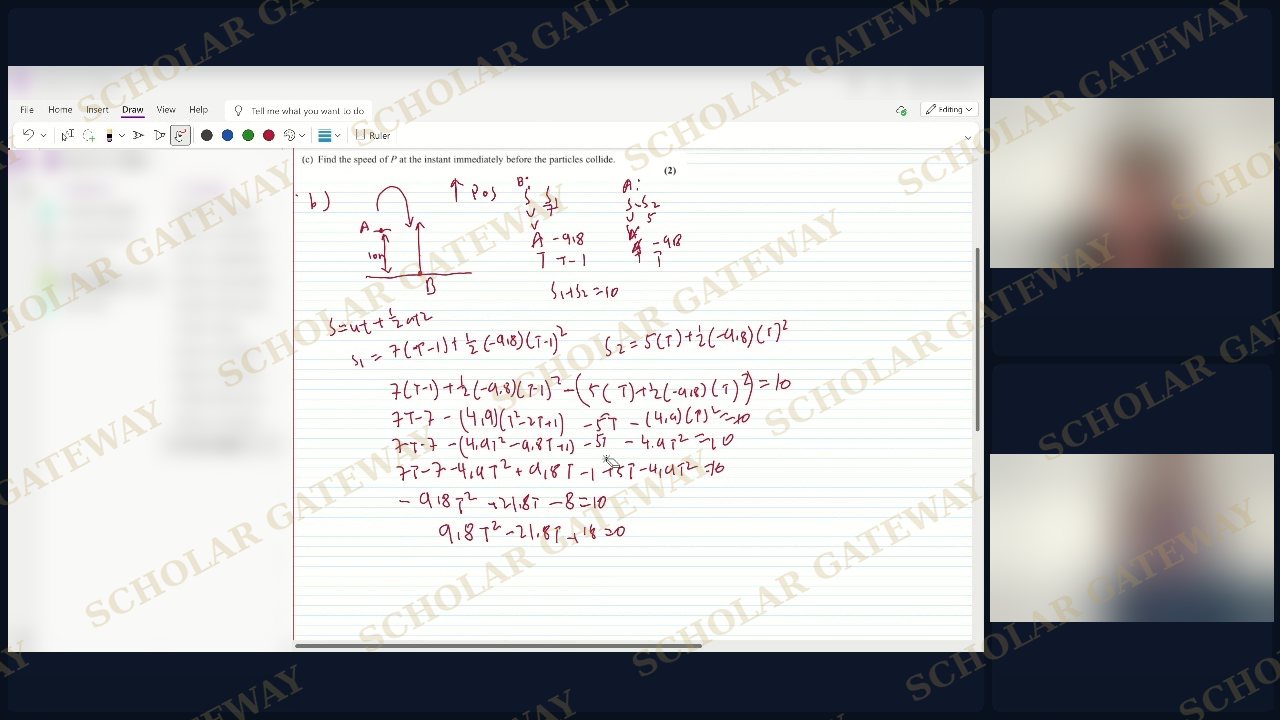
A-level Maths: working through a mechanics question step by step
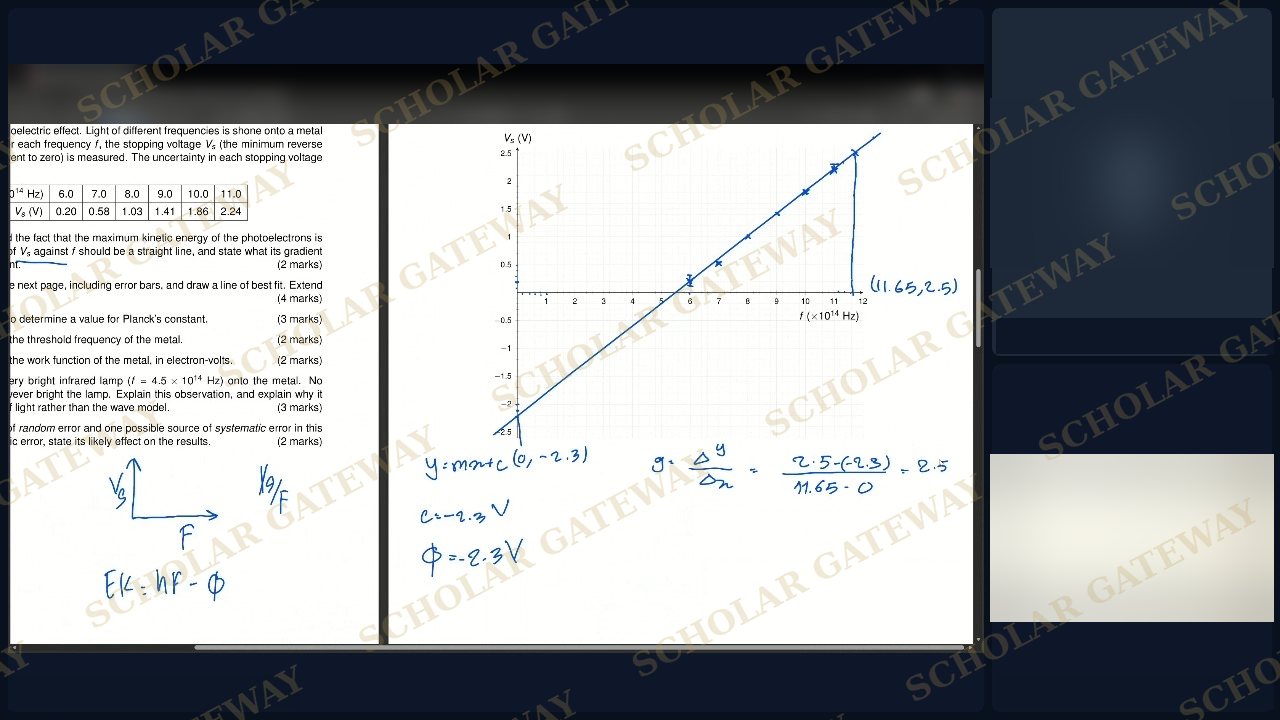
Physics: reading a gradient and intercept from a graph
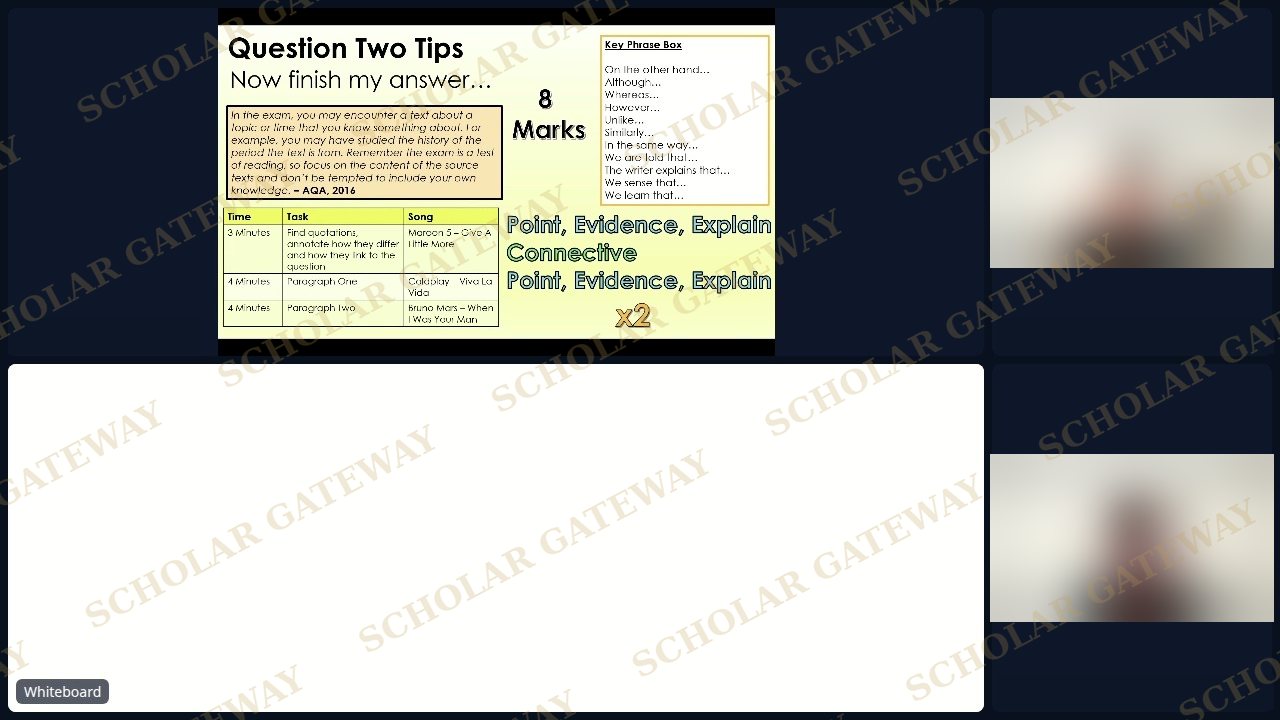
GCSE English: planning an exam answer
After the lesson: the tutor’s report
Chemistry · WJEC
Topics covered
Shells, subshells and orbitals · electronic configuration notation · Aufbau principle · Pauli exclusion principle · Hund’s rule
Tutor’s report
The objective of today’s lesson was for the student to understand how electrons are arranged in atoms and to develop the foundation needed to write electronic configurations accurately. …
The student was cooperative, engaged and able to recall the basic concepts well. … Her main area for improvement is giving more precise scientific answers and using exact chemical terminology, but this can be developed gradually through regular questioning and WJEC-style practice.
Plan for the next lesson: we will complete the remaining part of electronic configuration, including writing configurations for elements, noble-gas shorthand, the 4s and 3d filling pattern, d-block elements, the chromium and copper exceptions, and electronic configurations of ions.
Homework
No homework was set after today’s lesson because the topic is not yet complete. Homework will be given after we finish Electronic Configuration in the next lesson, so that the student can practise the complete topic rather than only part of it.
Physics · IB Higher Level
Topics covered
Kinematics · Forces and Momentum · static and dynamic situations · friction and normal force
Tutor’s report
Today’s objective was to assess the student’s current Physics level and what he remembers and understands from the lessons covered this year.
We worked on quick exercises from Kinematics, Forces, and Momentum. The student is good at visualizing and simplifying problems, but he tends to rely on memorized formulas rather than understanding when and why to use them. He also needs to improve his logical and organized reasoning, especially when dealing with different stages of a problem and using symbols correctly.
The main goal is to strengthen the student’s conceptual understanding and problem-solving method, rather than relying mainly on memorization. …
Homework
For the next lessons, the homework will change from mainly focusing on friction to focusing more on Chapters 1 and 2, with exercises specifically designed to develop logical reasoning and organized problem-solving.
Maths · A-level
Topics covered
A-level pure topics: past-paper review
Tutor’s report
We started with a review of [the student]’s homework on AS pure shadow paper 2023. He scored 91/100 which is really good. One question, on trig identities, we reviewed in more detail, to show a simpler approach. Most of the marks lost were slips …
Question 5 - small angle approximations - made an error with the formula for cos(theta) but self corrected. Question 6 - differentiation - chain rule - needs some more work in the future. Question 15 - implicit differentiation - clearly [the student] also needs to review this topic in detail. …
Homework
AS Shadow paper 2023 (stats and applied)
IELTS Speaking
Topics covered
IELTS Speaking Part 2
Tutor’s report
Today we continued developing IELTS Speaking Part 2, focusing on planning, extending ideas, reducing filler words, using more precise vocabulary and building stronger sentence structures. [The student] did reasonably well and was able to generate relevant ideas and apply the note-taking techniques.
His main areas for improvement are developing answers in greater detail, speaking closer to the full two minutes, reducing unnecessary fillers such as “like”, and using a wider range of vocabulary naturally.
Homework
For each topic, take 1 minute to make short notes and practise speaking for 2 minutes. Practise each speech several times, but do not write or memorise a full script. …
English · GCSE English Language
Topics covered
AQA GCSE English Language Paper 1, Question 2 and 3
Tutor’s report
Today’s objective was to practice and refine responses for AQA GCSE English Language Paper 1, focusing on Question 2 (language analysis) and introducing Question 3 (structural analysis). [The student] successfully completed a live paragraph-by-paragraph breakdown.
We also began exploring Question 3 structure, examining whole-text narrative shifts and tracking reader focus.
Long-Term Strategy: Her primary area for continued refinement is to consistently secure top-band (Level 4) marks under timed conditions.
Homework
Complete a full draft response for Question 3 based on the whole source
English · school exam preparation
Topics covered
Passive Voice across different tenses · Comparisons
Tutor’s report
The objective of today’s lesson was to prepare [the student] for her midterm examination by reviewing Passive Voice and Comparisons. …
She completed the exercises with a score of 9/10, showing that she can apply the concepts accurately. She was also more confident with Passive Voice than in the previous lesson, particularly because she had reviewed the past participle (V3) forms as part of her previous homework.
Her main area for continued practice is remembering and using V3 forms consistently when constructing Passive Voice sentences.
Homework
Reviewing past participle (V3) forms
Where would you like to start?
How it works
- 1
Book a free assessment
Tell us about your child and your goals.
- 2
Get a recommended plan
We suggest the course and the next step.
- 3
Start lessons
Lessons begin with a tutor matched to your child.
Choosing a UK school? Start with our guides
Plain-language guides to UK schools, entry exams, boarding and universities.
Common questions
Where do we begin?
Book the free assessment. It shows where your child is now and what to do next.
Do we need to know our child's level first?
No. The assessment works that out, so you do not need to choose a course in advance.
Which exams do you prepare students for?
UK school entrance exams (11+, 13+, ISEB, UKiset, CAT4), IGCSE, GCSE, A-Level and IB subjects. See the course pages for detail.
Can we talk to someone before booking?
Yes. Use the contact page and we will reply.
Ready to take the first step?
Stay connected